Dependency Injection in EJB 3
By Debu Panda
39,000 Downloads · Refcard 6 of 185 (see them all)
Download
FREE PDF
The Essential EJB 3 Dependency Injection Cheat Sheet
Dependency Injection in EJB 3
What is EJB 3?
Enterprise JavaBeans (EJB) is a platform for building portable, reusable, and scalable business applications using the Java programming language. Since its initial incarnation, EJB has been touted as a component model or framework that lets you build enterprise Java applications without having to reinvent services such as transactions, security, and automated persistence for building an application.
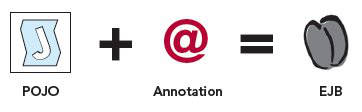
EJB 3 greatly simplifies development by adopting a POJO programming model. As shown in the following figure an annotation transforms a simple POJO to an EJB.
EJB 3 not only simplifies development of session and message driven beans but it also radically simplifies the persistence model by implementing a simplified Object-Relational Mapping approach similar to Oracle TopLink and JBoss Hibernate as a part of the Java Persistence API. Note that JPA replaces EJB 2 CMP Entity beans in the EJB 3 spec, while being available outside of the Java EE container.
Following is an example of a simple EJB 3 Stateless session bean.
import javax.ejb.Stateless;
import ejb3inaction.example.persistence.Bid;
@Stateless
public class PlaceBidBean implements PlaceBid {
...
public PlaceBidBean() {}
public Bid addBid(Bid bid) {
System.out.println("Adding bid, bidder ID="
+
bid.getBidderID()
+ ", item ID=" + bid.getItemID()
+ ", bid amount="
+ bid.getBidAmount() + ".");
r
eturn save(bid);
}
...
}
import javax.ejb.Local;
import ejb3inaction.example.persistence.Bid;
@Local public interface PlaceBid {
Bid addBid(Bid bid);
}
DEPENDENCY INJECTION IN EJB 3
With EJB 3, dependency injection has greatly simplified accessing both EJB resources"such as JDBC DataSource, JMS Objects, and JPA Entity Manager"and services"such as Timer, User Transaction, and Web Services. You will find this Refcard useful when building enterprise Java applications with EJB 3 and JPA. It lists all metadata annotations, describes them and provides examples. It also provides descriptions for XML elements that you can use for injection.
Most enterprise Java applications use external resources and services such as Data Source, EJB, or web services. EJB 3 makes using resources and services simpler by implementing dependency injection.
Dependency injection allows you to simply declare component dependencies and let the EJB container deal with the complexities of instantiating, initializing, and sequencing resources and supplying service or resource references to clients as required. Development frameworks like Spring framework originally popularized dependency injection.
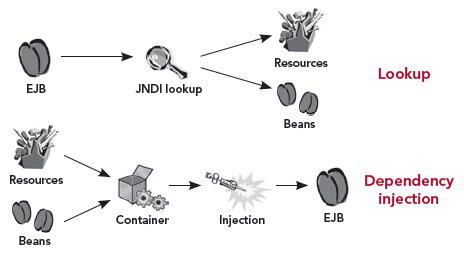
In EJB 3, you may think of dependency injection as the inverse of JNDI. It is the responsibility of the container to inject an object based on the dependency declaration. The figure below compares dependency injection with JNDI.
Note that annotations and descriptors are not mutually exclusive. In fact, you can use both together. Deployment descriptor entries override configuration values specified using metadata annotations.
You can use either metadata annotations or XML descriptors to use dependency injection.
Refer to the following Java EE 5 specifications and XML schema for more information on dependency injection.
JSR 220
Enterprise JavaBeans 3.0:
http://www.jcp.org/en/jsr/detail?id=220
JSR 224
Java API for XML-Based Web Services (JAX-WS) 2.0:
http://jcp.org/en/jsr/detail?id=224
JSR 250:
Common Annotations for the Java Platform:
http://jcp.org/en/jsr/detail?id=224
Schema for EJB 3 deployment descriptor:
http://java.sun.com/xml/ns/javaee/ejb-jar_3_0.xsd
Schema that defines common schema components:
http://java.sun.com/xml/ns/javaee/javaee_5.xsd
Dependency injection is supported only on managed classes and not on regular POJO.

Dependency injection is supported only on managed classes such as Session Beans or Interceptors and not on regular POJO. Hence you cannot use injection on helper classes.
The following table depicts what type of managed classes can inject what objects.
| Resources | Stateless | Stateful | MDB | Interceptors |
|---|---|---|---|---|
| JDBC DataSource | Yes | Yes | Yes | Yes |
| JMS Destinations, Connection Factories | Yes | Yes | Yes | Yes |
| Mail Resources | Yes | Yes | Yes | Yes |
| UserTransaction | Yes | Yes | Yes | Yes |
| Environment Entries | Yes | Yes | Yes | Yes |
| EJBContext | Yes | Yes | Yes | No |
| Timer Service | Yes | No | Yes | No |
| Web Service reference | Yes | Yes | Yes | Yes |
| EntityManager, EntityManagerFactory | Yes | Yes | Yes | Yes |
Java EE 5 introduced several metadata annotations as part of JSR 250. Although primarily geared toward EJB, these annotations also apply to Java EE components such as Servlets, JSF managed beans, and application clients.
The following annotations can be used in a field or a setter method for dependency injection. However, these annotations may also be applied at the class level for defining dependencies and then used with JNDI look up.
| Annotations | Usage | Components that can use |
|---|---|---|
| javax.annotation.Resource | Dependency injection of resources such as DataSource, and JMS objects | EJB, Web, Application Client |
| javax.ejb.EJB | Dependency injection of Session beans | EJB, Web, Application Client |
| javax.xml.ws.WebServiceRef | Dependency injection of Web services | EJB, Web, Application Client |
| javax.persistence.PersistenceContext | Dependency injection of container-managed EntityManager | EJB, Web |
| javax.persistence.PersistenceUnit | Dependency injection of EntityManagerFactory | EJB, Web |

Resource Injection
javax.annotation.Resource
The @Resource annotation is used to inject any of the following: JDBC data sources, JMS connection factories, JMS destinations, mail resource, environment entries, timer service, UserTransaction, and EJBContext.
The following table shows attributes for the @Resource annotation.
| Parameter | Type | Description | Default |
|---|---|---|---|
| authentication Type | enum Authentication Type {CONTAINER, APPLICATION} | The type of authentication required for accessing the resource. The CONTAINER value means that the container"s security context is used for the resource. The APPLICATION value means that authentication for the resource must be provided by the application. | CONTAINER |
| name | String | The referred resources is bound under this name in the enviornment-naming context as java:comp/env/<Name> | "" |
| type | Object | Type of the resource being referenced. Example: javax.sql.DataSource | Object.class |
| shareable | Boolean | Specifies whether the resource can be shared. | True |
| description | String | The description of the resource. | "" |
| mappedName | String | A vendor-specific name that the resource may be mapped to, as opposed to the JNDI name. | "" |
You can inject a resource at the field or setter method level.
The following example shows data source injection at the field level:
@Resource(name="jdbc/ActionBazaarDS")
private DataSource dataSource;
The following code shows data source injection at the setter method level:
private DataSource dataSource;
@Resource(name="jdbc/ActionBazaarDB")
public void setDataSource(DataSource dataSource) {
this.dataSource = dataSource;
}

Although setter injection might seem like a little more work, it provides a couple of distinct advantages. First, it is easier to unit-test by invoking the public setter method from a testing framework like JUnit. Second, it is easier to put initialization code in the setter if you need it.
EJB 3 allows you to explicitly specify a global JNDI name using the mappedName parameter of the @Resource annotation. For example, if you"re using the Oracle Application Server and you have a data source with a global JNDI name of jdbc/OracleDS, you can specify the resource mapping as follows:
@Resource(name="jdbc/ActionBazaarDS", mappedName="jdbc/ OracleDS")
private javax.jdbc.DataSource myDB;
XML elements to define Resource Injection
If you are using deployment descriptor (ejb-jar.xml) instead of annotations, then you must use resource-ref, resource-env-ref or env-entry XML elements to define dependencies.
resource-ref
The resource-ref is used to specify resource references. Example: data source and JMS connection factories.
| Element/Attribute Name | Description |
|---|---|
| res-ref-name | The name used to bind the referenced resource into the ENC. Same as the name element in the @Resource annotation. |
| mapped-name | A vendor-specific global JNDI name for the referenced resource. |
| res-type | Fully qualified class of the type of resource referenced. Example: javax.sql.DataSource. |
| res-auth | Authentication type for the resource. Valid values are Container or Application. |
| res-sharing-scope | Specifies whether multiple beans can share the resource. Valid values are Shareable and Unshareable |
| injection-target | Target where the referenced resource is injected when dependency injection is used. |
<resource-ref>
<res-ref-name>jdbc/ActionBazaarDS</res-ref-name>
<res-type>javax.sql.DataSource</res-type>
<res-auth>Container</res-auth>
<res-sharing-scope>Shareable</res-sharing-scope>
<injection-target>
<injection-tar
get-class>
actionbazaar.buslogic.BidManagerBean</injection-target-class>
<injection-tar
get-name>dataSource</injection-target-name>
</injection-target>
</resource-ref>
resource-env-ref
The resource-env-ref is used to specify references to JMS destination resources such as a Queue or Topic.
| Element/Attribute Name | Description |
|---|---|
| resource-env-ref-name | The name used to bind the referenced JMS destination to the ENC. Same as the name element in the @Resource annotation. |
| mapped-name | A vendor-specific global JNDI name for the referenced JMS destination. |
| resource-env-type | Type of JMS destination referenced, such as javax.jms.Queue or javax.jms.Topic. |
| injection-target | Target where the referenced destination is injected when dependency injection is used. |
<resource-env-ref>
<resource-env-ref-name>jms/OrderBillingQueue</resource-env-ref-name>
<resource-env-ref-type>
javax.jms.Destination
</resource-env-ref-type>
<injection-target>
<injection-target-class>
ejb3inaction.example.buslogic.PlaceOrderBean
</injection-target-class>
<injection-tar
get-name>billingQueue</injection-target-name>
</injection-target>
</resource-env-ref>
env-entry
The env-entry defines environment entries for an EJB.
| Element/Attribute Name | Description |
|---|---|
| env-entry-name | The name used in the environment entry in the ENC. Same as the name element in the @Resource annotation. |
| env-entry-type | Type of the env entry used. Legal types are java.lang.Boolean, java.lang.Byte, java.lang.Character, java.lang.String, java.lang.Short, java.lang.Integer, java.lang.Long, java.lang.Float, and java.lang.Double. |
| env-entry-value | Value specified for the environment entry. |
| injection-target | Target where the referenced destination is injected when dependency injection is used. |
The injection-target defines the name of a class and a name (field or property) within that class into which a resource, EJB, or entity manager should be injected as we saw in the above examples.
| Element/Attribute Name | Description |
|---|---|
| injection-target-class | The fully qualified name of the class into which a resource, EJB, or entity manager should be injected. |
| injection-target-name | Name of the injection target, i.e., the name of the property or field in the injection target class. |
INJECTION OF SESSION EJB REFERENCES
Like resource injection, you can inject Session bean references into another EJB or other managed class using annotations or deployment XML. If you prefer annotations you can use @javax.ejb.EJB annotations to inject either remote or local EJB references. Using deployment XML, you can inject remote EJB references with ejb-ref and local EJB references with ejb-local-ref.
@javax.ejb.EJB
Injects a session bean reference into a field or method.
| Parameter | Type | Description | Default |
|---|---|---|---|
| name | String | The name used to bind the referenced EJB to the ENC. | "" |
| beanInterface | Class | The bean interface used to access the EJB | Object.class |
| mappedName | String | Type of the resource being referenced. Example: javax.sql.DataSource | "" |
| beanName | String | Specifies whether the resource can be shared. | "" |
| description | String |
@EJB(name="BidManagerRemote")
private BidManager bidManager;

You must not inject a Stateful session bean into a stateless object, such as a stateless session bean or servlet that may be shared by multiple concurrent clients (you should use JNDI in such cases instead). However, injecting an instance of a stateless session bean into a stateful session bean is perfectly legal.
ejb-local-ref
Used to specify a dependency on the local interface of a session bean.
| Element/Attribute Name | Description |
|---|---|
| ejb-ref-name | The name used to bind the referenced EJB to the ENC. Same as the name element in the @EJB annotation. ejb-ref-name must be specified. |
| ejb-link | The name of the target enterprise bean. This optional setting is used to link an EJB reference to a target enterprise bean. |
| local | The EJB 3 local business interface. |
| ref-type | The EJB reference type, i.e. "session". |
| injection-target | Target where the EJB reference is injected when dependency injection is used. |
ejb-ref
Used to specify a dependency on the remote interface of a session bean.
| Element/Attribute Name | Description |
|---|---|
| ejb-ref-name | The name used to bind the referenced EJB to the ENC. Same as the name element in the @EJB annotation. ejb-ref-name must be specified. |
| ejb-link | The name of the target enterprise bean. This optional setting is used to link an EJB reference to a target enterprise bean. |
| remote | The EJB 3 remote business interface type. |
| ref-type | The EJB reference type, i.e. "session". |
| injection-target | Target where the EJB reference is injected when dependency injection is used. |

EJB 3 specification does not require injecting references of remote EJB into a different instance of container. For example if you have an EJB with a remote interface deployed into an instance of a container, EJB 3 specification does not require injecting instance of that EJB into another EJB deployed in another container.
Injecting JPA Resources
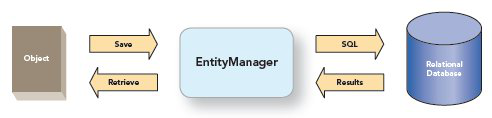
The JPA EntityManager is the bridge between the OO and relational worlds as depicted in the following figure.
JPA supports two types of EntityManager: container-managed and application-managed. As the name suggests the lifecycle of the container manages container-managed EntityManager whereas the lifecycle (creation, destruction) is performed by application. An application-managed EntityManager is created from an EntityManagerFactory.
Injecting container-managed EntityManager
You can inject a container-managed EntityManager (either transaction scoped or extended) using @javax.persistence.PersistenceContext annotation.
@javax.persistence.PersistenceContext
The following table defines the parameters/attributes of this annotation.
| Parameter | Type | Description | Default |
|---|---|---|---|
| name | String | The name used to bind the referenced persistence context to the ENC | "" |
| unitName | String | Name of the persistence unit referenced | "" |
| type | Persistence ContextType | Type of persistence context, i.e., Transaction or Extended. Extended is supported only in stateful session beans. | TRANSACTION |
| properties | Persistence Property[] | A name value-pair of vendor-specific persistence properties | {} |
You can inject a transaction scoped EntityManager as follows:
@PersistenceContext(unitName="actionBazaar")
private EntityManager entityManager;
An extended scoped EntityManager can only used in a stateful session bean as in the following example:
@Stateful
@TransactionAttribute(TransactionAttributeType.NOT_SUPPORTED)
public class PlaceOrderBean implements PlaceOrder {
@PersistenceContext(unitName = "actionBazaar", type =
PersistenceContextType.EXTENDED)
EntityManager em;
The persistence-context-ref is similar to @PersistenceContext; it defines references to a container-managed entity manager.
| Element/Attribute Name | Description |
|---|---|
| persistence-context-ref-name | The name used to bind the referenced persistence context to the ENC. Same as the name element in the @PersistenceContext annotation. |
| persistence-unit-name | Name of the persistence unit referenced. |
| persistence-context-type | Type of persistence context, i.e., Transaction or Extended. Extended is supported only in stateful session beans. |
| persistence-property | A name value-pair of vendor-specific persistence properties. |
| injection-target | Target where the EntityManager is injected when dependency injection is used. |
<persistence-context-ref>
<persistence-conte
xt-ref-name>
A
ctionBazaar
</persistence-conte
xt-ref-name>
<persistence-unit-name>actionBazaar</persistence-unit-name>
<persistence-conte
xt-type>Transaction</persistence-context-type>
<injection-tar
get>
<injection-target-class>
ejb3inaction.example.buslogic.PlaceBidBean
</injection-target-class>
<injection-target-name>em</injection-target-name>
</injection-tar
get>
</persistence-context-ref>
Injecting EntityManagerFactory
@javax.persistence.PersistenceUnit
@Stateless
public class ItemManagerBean implements ItemManager {
@PersistenceUnit
private EntityManagerFactory entityManagerFactory;
private EntityManager entityManager;
@PostConstruct
public void initialize() {
entityManager = entityManagerFactory.createEntityManager();
}
}
| Parameter | Type | Description | Default |
|---|---|---|---|
| name | String | The name used to bind the referenced persistence context to the ENC | "" |
| unitName | String | Name of the persistence unit | "" |
The persistence-unit-ref is similar to @PersistenceUnit that is used to define references to a persistence unit (i.e., entity manager factory).
| Element/Attribute Name | Description |
|---|---|
| persistence-unit-ref-name | The name used to bind the referenced persistence unit (EntityManagerFactory) to the ENC. Same as the name element in the @PersistenceUnit annotation. |
| persistence-unit-name | Name of the persistence unit referenced. |
| injection-target | Target where the EntityManagerFactory is injected when dependency injection is used. |
Injecting Web Service References
@javax.xml.ws.WebServiceRef
| Element | Description |
|---|---|
| name | The JNDI name for the web service. |
| wsdlLocation | The WSDL location for the service. If not specified, then it is derived from the referenced service class. |
| type | The Java type of the resource. |
| value | The service class, always a type extending javax.xml.ws.Service. |
| mappedName | Vendor-specific global JNDI name for the service. |
You can inject an endpoint interface as follows:
@WebServiceRef(TrackDeliveryService.class)
private TrackDeliverySEI deliveryService;
You can inject a service interface as follows:
@WebServiceRef
private TrackingService service;
service-ref
The service-ref XML element is used to specify dependency on a web service if you are using deployment descriptor. The following table contains only the elements that are used from EJB clients.
| Element/Attribute Name | Description |
|---|---|
| service-ref-name | The name used to bind the referenced web service into the ENC. Same as the name element in the @WebServiceRef annotation. |
| service-interface | Fully qualified class for the JAX-WS service interface the client depends on., i.e. javax.xml.rpc.Service. |
| service-ref-type | Type of service that will be returned. |
| wsdl-file | The URL location of the WSDL. |
| handler-chains | Defines handler chain. |
| injection-target | Target where the web service reference is injected when dependency injection is used. |
The detailed schema for the service-ref can be found online at java.sun.com/xml/ns/javaee/javaee_web_services_client_1_2.xsd.
INJECTING SPRING BEANS IN EJB 3
The Spring Framework is one of the driving forces behind popularizing the POJO programming model and dependency injection. In this section we will examine how you can inject and use Spring POJOs into EJB 3 Session beans or Message Driven Beans.
The Spring framework provides factory classes based on the following abstract classes that you use to develop Spring-enabled EJBs.
| Support Class | Purpose |
|---|---|
| AbstractStatelessSessionBean | Used for Spring-enabled stateless session beans. |
| AbstractStatefulSessionBean | Used for Spring-enabled stateful session beans. |
| AbstractJMSMessageDrivenBean | Used for Spring-enabled JMS message-driven beans. |
| AbstractMessageDrivenBean | Used for Spring-enabled connector-based MDBs. |
To use a Spring factory class to access a Spring bean, your EJB 3 bean class must implement the onEjbCreate() method.
Below is the PlaceBidBean EJB 3 example transformed into a Spring-enabled stateless session bean. Here the PlaceBidBean acts as a fa"ade and delegates the actual business logic to the PlaceBidServiceBean. The PlaceBidServiceBean is a Spring POJO that may use the full power of the Spring framework.
@Stateless(name = "PlaceBid")
public class PlaceBidBean extends AbstractStatelessSessionBean
implements PlaceBid {
private BidServiceBean bidService;
public PlaceBidBean() {
}
protected void onEjbCreate() {
bidService =
(BidServiceBean) getBeanFactory().getBean("bidService");
}
public Long addBid(String userId, Long itemId, Double bidPrice) {
return bidService.addBid(userId, itemId, bidPrice);
}
When an EJB instance is created (when a client invokes an EJB), the onEjbCreate method is invoked automatically. A JNDI lookup is performed to obtain the path for the bean factory by using an environment entry named ejb/BeanFactoryPath. So you have to define it in the EJB deployment descriptor for the EJB:
<session>
<display-name>PlaceBid</display-name>
<ejb-name>PlaceBid</ejb-name>
<env-entry>
<env-entry-name>ejb/BeanFactoryPath</env-entry-name>
<env-entry-type>java.lang.String</env-entry-type>
<env-entry-value>/actionBazaar-service.xml</env-entry-value>
</env-entry>
</session>
Although EJB 3 made deployment descriptor optional there are a few cases where you still have to use it. In our example we"ve set the env-entry-value for the ejb/BeanFactoryPath environment variable at /actionBazaar-service.xml. So you have to package the EJB classes, Spring classes, and Spring configuration file into your ejb-jar package. The Spring bean factory (configuration file) defines the Spring beans. Refer to the Spring Configuration Refcard for details about Spring configuration.